
By My Van Nguyen Dang
In February this year, I saw a post shared by Public Libraries Victoria about an IFLA Emerging Leaders grant to support attendance at the World Library and Information Congress (WLIC). I wondered, should I apply? I would be competing with applicants from around the world. My team leader said, “Just put your hat in the ring and give it a go, you might be surprised.” Clearly, she had more confidence in me than I had. I’m glad she did.
The announcement was due on 1 April, and I spent the whole day checking my inbox. Nothing. My team leader later told me she had been ready to comfort me, until we realised they meant 1 April, Amsterdam time. Hah! That evening, I was in bed trying to ignore the fact that their workday would already have begun and I still had not heard anything. I was getting ready to sleep when a notification appeared on my phone at 12.52 am. My first thought was, I didn’t get it, until I saw the subject line: Congratulations you’ve been selected for IFLA’s Emerging Leaders grant 2026! My second thought was, this must be spam. The sender’s name was a single word in lowercase, “grants”. You can’t blame me, this was my eSafety training kicking in. Once I had confirmed that the email was legitimate, I was so excited! I snipped it and sent it to my team leader at 12.53 am. Then I went online and bought myself a Sanrio Labubu blind box to celebrate!
That was the journey from applying for the IFLA Emerging Leaders grant to receiving it. Attending WLIC was an entirely different adventure.
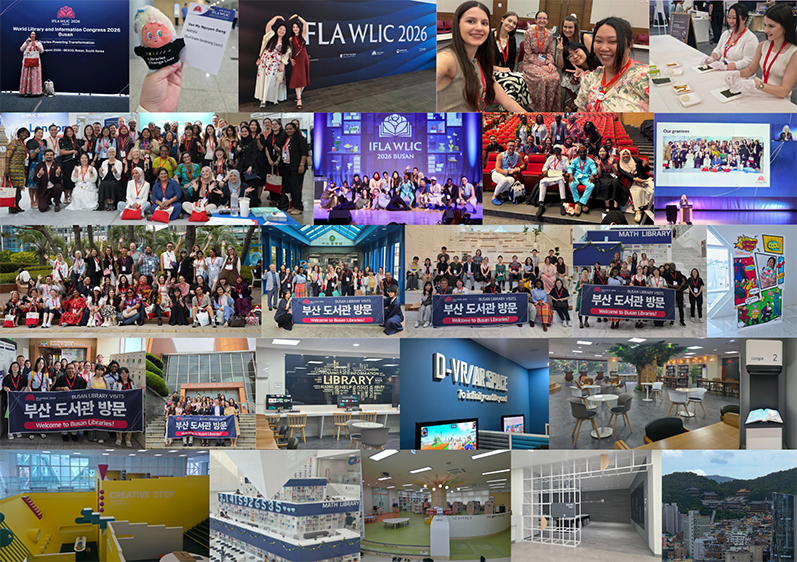
The learning began well before WLIC. One of our pre-congress tasks involved applying futures thinking concepts, and the work became the foundation for a presentation we would deliver at WLIC. Yes, we had to give a presentation. At WLIC. Yay. Anyway, back to the story. Many of the 16 Emerging Leaders for 2026 finally met in person on 8 August at Busan BEXCO. You can read about us here, Meet the 2026 Emerging Leaders. Stephen Wyber led the conversation, sharing advice on how to make the most of WLIC and discussing our presentation, scheduled for the Tuesday of the Congress. It was wonderful to meet the other Emerging Leaders, everyone had already done so many amazing things for their communities!
On Sunday, 9 August, I attended business meetings of the IFLA Public Libraries Section, the Library Services to Multicultural Populations Section, the Libraries for Children and Young Adults Section, and the Australia and New Zealand Caucus. It was a valuable opportunity to hear about each section’s work and consider how we could bring that experience and knowledge back to our own library services.
WLIC sessions ran from Monday to Wednesday. There were so many inspiring sessions, with speakers from different parts of the world. It was striking to see that, although we came from different places, the communities we serve and the challenges we face were often very similar.
For the Emerging Leaders, Tuesday was the most nerve-racking day because it was our presentation session. If you are interested, you can read about it here, Futures Club #3: The Present is an Accident. We had imagined our session would be held in one of the smaller rooms. With so many interesting concurrent sessions, we did not expect a large audience. But behold, they put us in the Auditorium, where the opening and closing ceremonies were held. The audience was also larger than we had anticipated, but we got up there and delivered our part!
On the final day of WLIC, Thursday, 13 August, we joined a library tour around Busan. There were several streams to choose from, mine visited Dong-Eui University Central Library, Busan English Library, the Mathematics Cultural Center, and Busan Metropolitan Simin Library. Dong-Eui University Central Library had undergone renovations in recent years, and we were welcomed by the Library Director and a student wearing traditional Korean hanbok. One interesting feature were these AI reading recommendation machines that asked users for information and then suggested books they might enjoy. There was also a dedicated VR space and a gaming room where students could take a break from studying. Busan English Library, the only English public library in Busan, offered an extensive collection for adults and children, along with programs encouraging children to read in English. The Mathematics Cultural Center was an impressive space filled with interactive exhibitions showing how maths can be used in everyday life. Many of its volunteers were retired maths teachers. The center also housed an extensive children’s maths collection, and many schools brought students there for interactive learning. Busan Metropolitan Simin Library was Busan’s first public library, opening its doors to the public in 1901. It had an extensive collection for adults, children, and students. A highlight was the variety of technology used throughout the library. AI machines offered reading recommendations based on borrowing history, sensor-powered research tables helped users find connections between research topics, and a machine that displayed digitised rare books. The library houses a rare books collection and has a digitisation team that makes these materials available to the public in interactive formats. The device projects a digitised work onto a blank book, when you turn a physical page, the projected content changes with the movement. Interactive points on the pages can also be touched to reveal more information.
It was an extraordinary experience, and I feel incredibly fortunate to have attended. I returned home with new ideas, new connections, and a renewed appreciation for the shared purpose that brings library professionals together across the world.
0 Comments